
We speak to families every day who are somewhere in that first week and worried they are forgetting something. Almost nobody is. In Ireland the funeral director carries most of the load, and the jobs that genuinely need you are shorter than you would think. Memorial cards are not one of them — they come later, and that is completely normal.
Day one: the death is confirmed
A doctor or the hospital confirms the death and completes the medical certificate of cause of death. If the death happened at home and was expected, the family doctor is called. If it was sudden or unexplained, the coroner becomes involved and the paperwork follows a different path — the funeral director will explain what that means for timings.
Once the death is confirmed, the next call is to a funeral director. From that point they take over the practical arrangements: the removal, the church, the burial or cremation, the notice, the flowers and the timings.
The funeral director does most of the work
Families are often surprised by how much sits with the funeral director rather than with them. Expect them to handle the church and cemetery bookings, the coffin, transport, the death notice, the order of service booklets and the gravediggers.
What is left for the family is usually the personal part: who carries the coffin, who reads, which hymns, which photograph, and who needs to be told.
- Decide burial or cremation, and which cemetery or crematorium.
- Agree the times for the removal, the wake or reposing, and the funeral Mass or service.
- Choose readings, hymns, prayers of the faithful and pall bearers.
- Nominate one person to answer the phone and take messages for the household.
The death notice
In Ireland the death notice does a lot of work in a short space of time. It tells the wider community that the person has died, where and when the funeral is, and how to sympathise. The funeral director normally places it, and it usually appears on rip.ie as well as being read out locally and on local radio in many areas. RIP.ie is an independent service and nothing to do with us — we mention it because it is where most Irish families now read notices.
It is worth reading the notice carefully before it goes up. The names, the townland spelling and the order of family members are exactly the details people notice, and they are the same details that will later go on the memorial card.
The wake, removal and funeral
Most Irish funerals happen within two to four days of the death. There may be reposing at home or at the funeral home, a removal to the church, and then the funeral Mass or service the following morning.
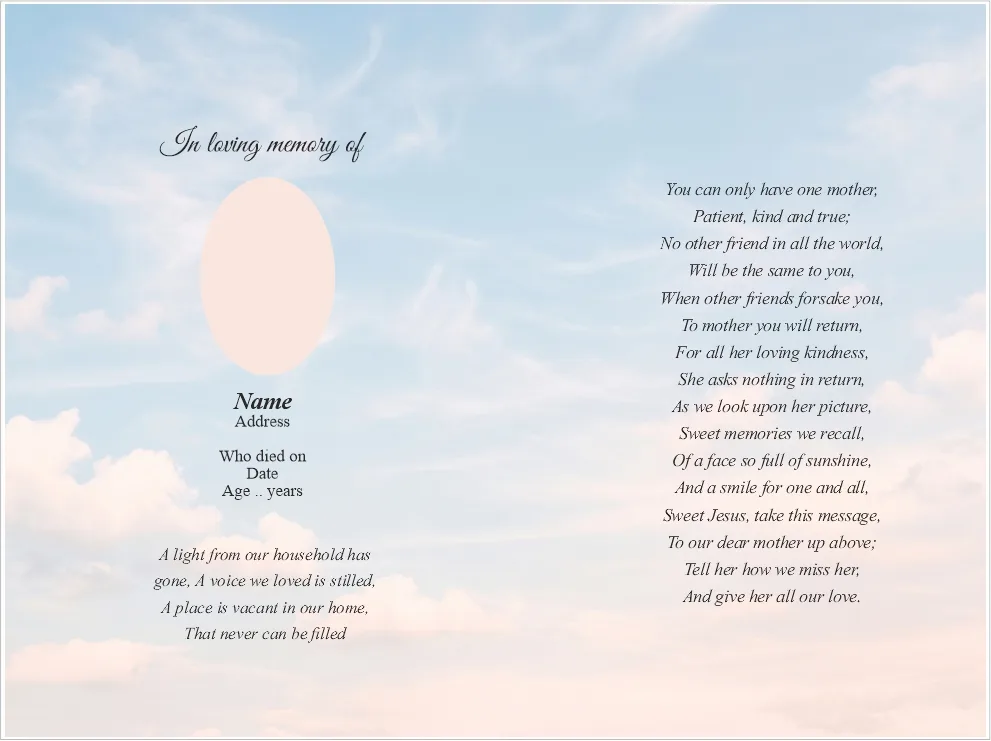
Order of service booklets are sometimes printed for the church. These are a different thing from memorial cards — booklets are for the day itself, memorial cards are keepsakes given out afterwards, so do not feel you need both at once.
Registering the death
The death must be registered with the civil registration service, and a death certificate is needed for banks, insurers, pensions and probate. You have three months to do it, so nobody needs to be dealing with this in the first week.
The funeral director will tell you what documents you need. Order several copies of the death certificate while you are at it — institutions rarely accept photocopies and you will be asked for it more often than you expect.
Money matters that can wait a fortnight
There are supports available, including a bereavement grant through a deceased person's insurance in some cases, the widow's, widower's or surviving civil partner's pension, and help with funeral costs in certain circumstances. None of it is urgent in week one and all of it is easier when you have the death certificate in hand.
Notify the bank, pension provider and insurers when you are ready rather than immediately. Accounts do not disappear.
Where memorial cards actually fit
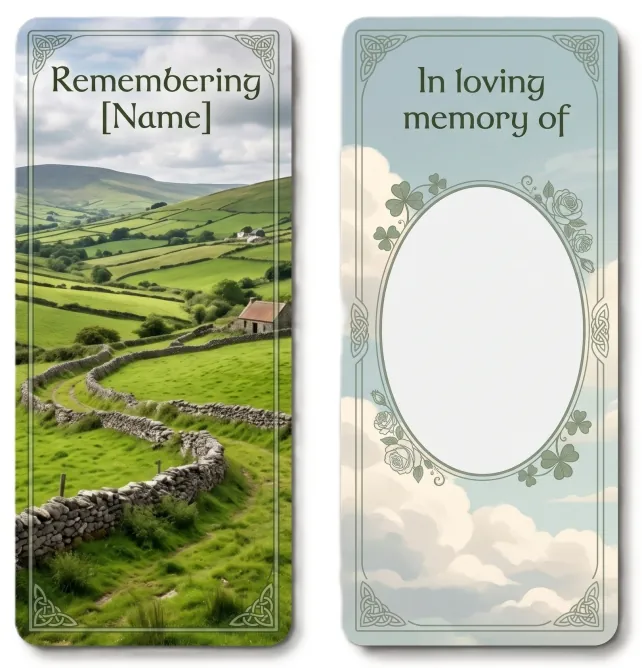
This is the question we are asked most often, so here is the honest answer: almost nobody orders memorial cards in the first week. The vast majority of our orders come in between three weeks and eighteen months after the funeral, and a large share are for the month's memory or the first anniversary.
There is a practical reason as well as an emotional one. In the first week you do not yet know how many cards you need — the sympathy cards, Mass cards and callers to the house tell you that. Waiting means you order the right quantity once, rather than reprinting.
| When | What happens | Memorial cards? |
|---|---|---|
| Days 1–4 | Doctor, funeral director, notice, wake, funeral | No — nothing needed yet |
| Weeks 1–3 | Thank you list, death certificate, paperwork | Start gathering photographs |
| Weeks 3–6 | Month's memory Mass in many parishes | A common time to order |
| Months 2–12 | Life settles, anniversary approaches | Most orders are placed here |
Month's memory and anniversary cards →How much memorial cards cost →
Two small things worth doing now
First, keep a written list of everyone who called, sent flowers, sent a Mass card or travelled. That list becomes both your thank you card list and your memorial card quantity.
Second, put the good photographs somewhere safe — a folder on a phone, or one envelope in a drawer. Families spend far longer hunting for the photograph later than they do choosing the verse.
Thank you and acknowledgement cards →Choosing the right photograph →
When you are ready, we are here
There is no deadline on a memorial card and no wrong time to order one. When you are ready, a name, a home place, the dates, a photograph and a verse are all we need, and you will see a proof before anything is printed.
Design and VAT are included in every price. Delivery anywhere in Ireland is free on orders over €150, or you can collect free from our shop in Gorey.
Frequently asked questions
- How long do you have to register a death in Ireland?
- Three months. It is not something that needs doing in the first week, and the funeral director will tell you what documents the registration office needs.
- Who places the death notice?
- The funeral director normally places it on the family's behalf, most often on rip.ie as well as locally. Read it over before it goes up — names and townland spellings are worth checking.
- When should we order memorial cards?
- Whenever you are ready. Most Irish families order between three weeks and eighteen months after the funeral, often for the month's memory or the first anniversary.
- Are order of service booklets the same as memorial cards?
- No. Booklets are used at the funeral service itself. Memorial cards are keepsakes given or posted to family and friends afterwards, and are usually ordered later.
Sources and further reading
Need help with a memorial card?
Design and VAT are included, and we will email or WhatsApp a proof before anything is printed.
Talk to our design team