
Ireland has one of the strongest remembrance cultures in Europe, and the memorial card sits right at the centre of it. Wakes, months' memories, anniversary notices and cards kept in missals are all part of the same habit: keeping the dead present in daily life.
The wake, the funeral, and the card that outlasts them
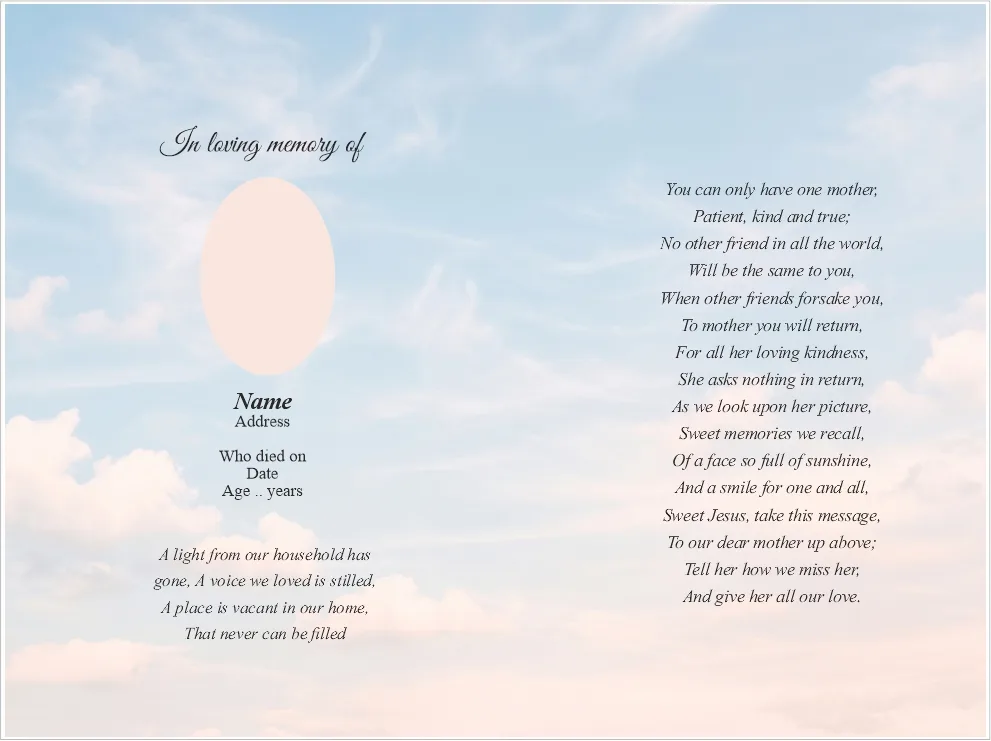
The Irish wake brings neighbours into the house, and the funeral brings the parish into the church. Both are intense and over quickly. The memorial card is what remains afterwards — a small, printed object that travels home in a coat pocket and stays in a purse, a missal or behind glass for decades.
Researchers who study Irish death rituals point out how much has changed in a generation: funeral homes, online notices and livestreamed masses are now normal. The printed keepsake is one of the few elements that has barely changed at all.
The month's memory
The month's memory mass, held roughly four weeks after the funeral, is when many families first hand out memorial cards. By then the immediate rush is over, photographs have been found, and there is time to choose wording properly.
Because of that timing, plenty of families order cards two or three weeks after a death rather than in the first few days. There is no “too late” — we print anniversary cards for deaths from decades ago.
Anniversaries and remembrance notices
The first anniversary is marked with a mass, often a notice in the local paper or on a death-notice website, and a fresh set of cards. Later anniversaries — tenth, twenty-fifth — are marked the same way in many families, sometimes with a new photograph or a different verse.
Anniversary cards usually carry a dated line: “In Loving Memory on your First Anniversary”, or “Died 3rd June 2025”. It is a small piece of wording that changes the whole meaning of the card.
Mortuary cards, memoriam cards, mass cards
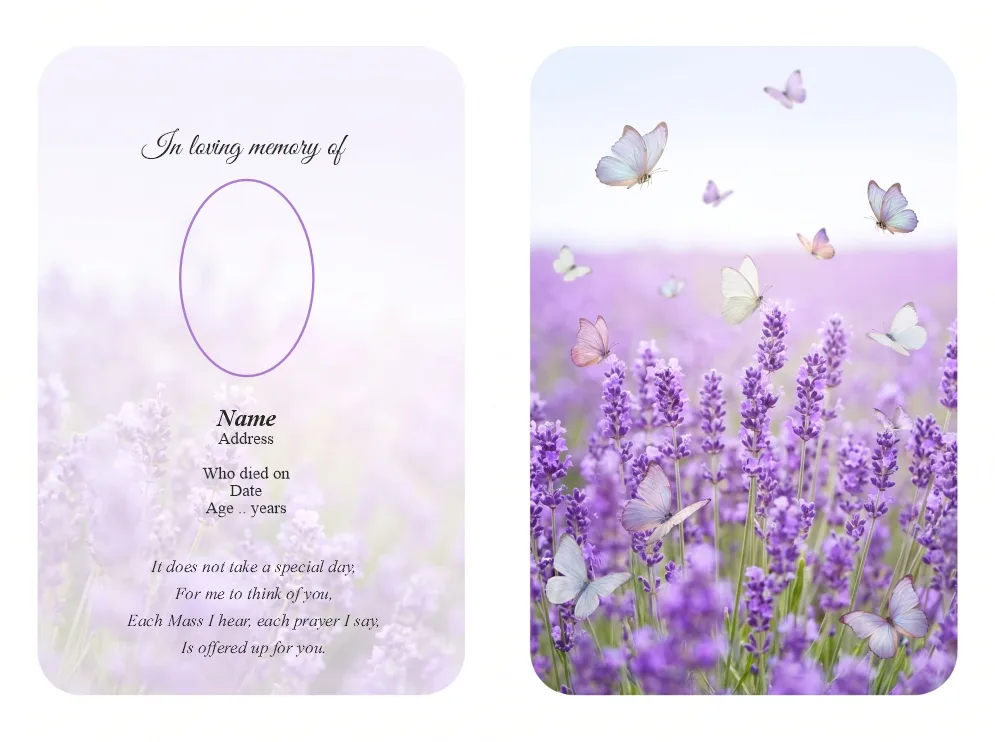
The vocabulary varies by county and generation. Older families often say mortuary card or memoriam card for what younger families call a memorial card, and a mass card is a different thing again — a card given to the bereaved to say a mass will be offered.
All of it points at the same tradition of printed remembrance, and we set them all. If you are unsure which you need, we have written a plain guide to the terms.
Celtic symbols and what they mean
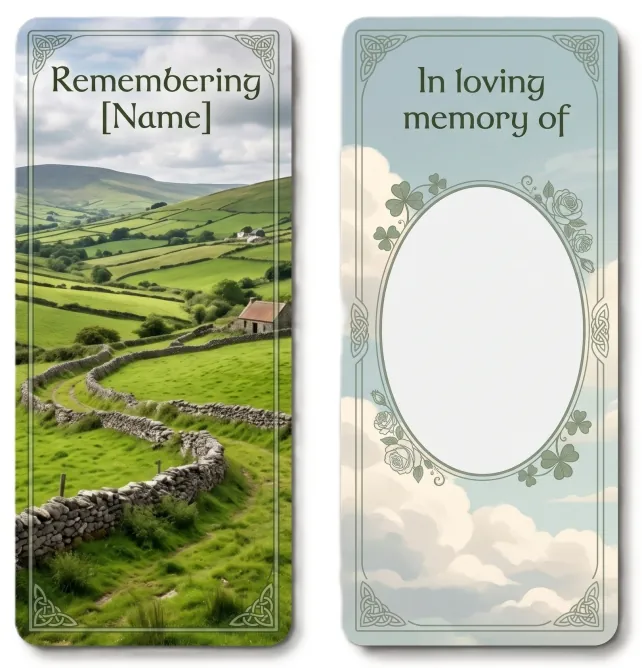
Celtic knotwork has no beginning and no end, which is why it appears on so many Irish memorial cards. High crosses reference the great stone crosses at Monasterboice and Clonmacnoise. The Claddagh carries love, loyalty and friendship. Interlaced borders do quietly what a long verse does at length.
Nature imagery is just as traditional in practice: a Wexford harvest field, a Kerry sunset, a boat on the Shannon. Families choose the landscape the person is associated with, and it dates far less quickly than a decorative frame.
Keepsakes that stay in use
Bookmarks are kept in missals and novels. Wallet cards are carried in purses and taken out at wakes years later. Folded cards go behind glass on a shelf or into a memory box with the funeral booklet.
That is why we ask families how the card will be used rather than only what it should look like. The format is a decision about the next twenty years, not about the day of the mass.
Frequently asked questions
- What is a month's memory in Ireland?
- A mass offered about four weeks after a funeral. It is a traditional point at which families hand out memorial cards, since there has been time to gather photographs and choose wording.
- When are Irish memorial cards usually given out?
- Most often at the month's memory or the first anniversary mass, and afterwards to family, neighbours and friends who could not attend the funeral.
- Is it too late to order memorial cards years after a death?
- No. Anniversary cards are ordered years and even decades later, and are one of the most common jobs we print.
Sources and further reading
Need help with a memorial card?
Design and VAT are included, and we will email or WhatsApp a proof before anything is printed.
Talk to our design team