
Most families order a memorial card once or twice in a lifetime, usually in the middle of a very hard week. This is the running order our designers work through when we set a card, so nothing important is left out and nothing has to be reprinted.
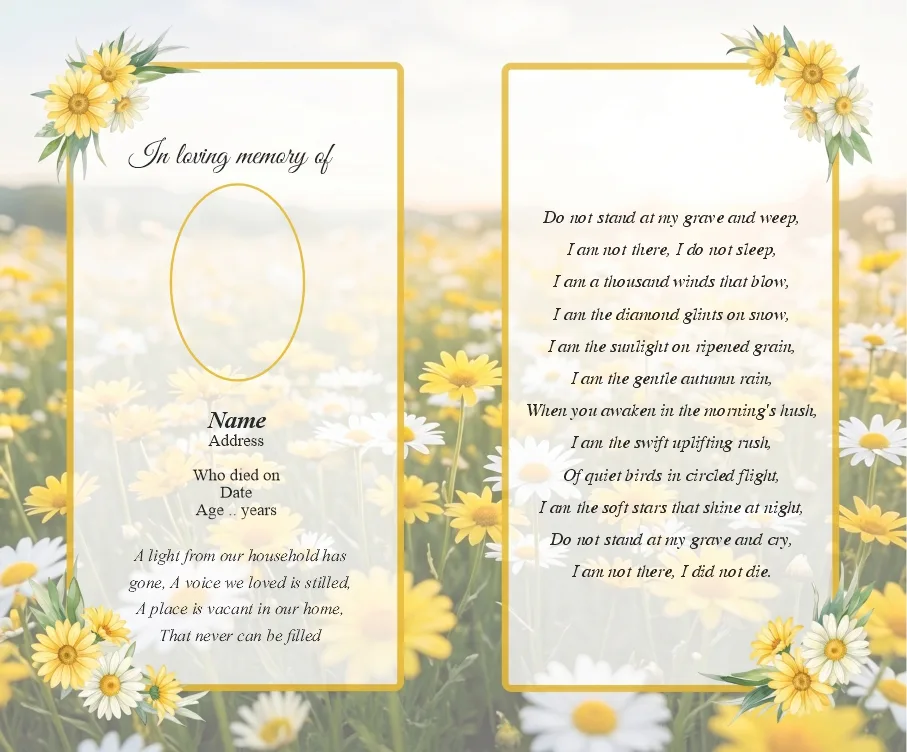
The five things every memorial card needs
Whatever the format, an Irish memorial card carries the same core information. Everything else — borders, colours, a second photograph — is presentation.
- A heading: “In Loving Memory Of”, “Treasured Memories Of”, “In Loving Memory of Our Dear Mother”.
- The full name, including a maiden name where it is used.
- The home place: townland, village or street, then the county.
- The dates: date of birth and date of death, or the date of death alone.
- A verse, prayer or short message of remembrance.
The front of the card
The front usually carries the heading, the photograph, the name, the home address or townland, and the dates. A clear, well-lit photograph works better than a formal one taken at a distance — the printed area is small, so the face needs to be big enough to read at arm's length.
If a maiden name is used, we set it on its own line under the name so it reads naturally rather than being squeezed into brackets. Irish spellings, fadas and Irish-language versions of a name are all set exactly as you write them, so send them the way the family wants them printed.
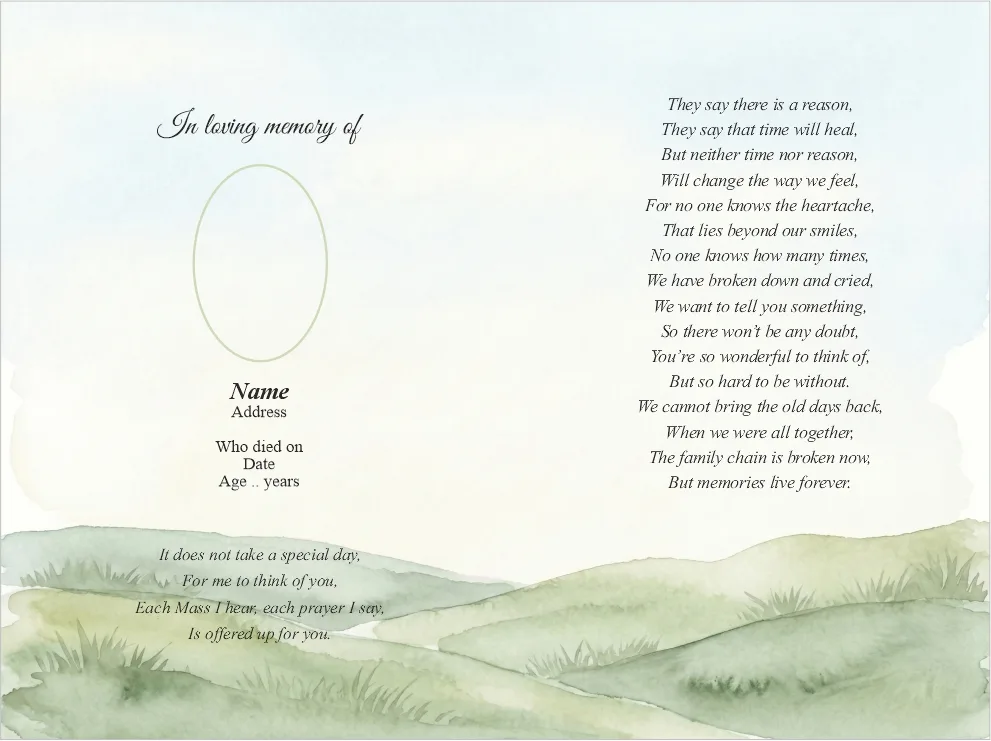
How to write the address
Write the address the way the family says it out loud, not the way a courier would print it. “Ballyduff, Bunclody, Co. Wexford” reads correctly on a card; “Unit 4, Ballyduff Road” does not. For a person who moved late in life, many families use the home place they are associated with rather than a nursing home address, and some add “late of” before an earlier address.
Place names are the detail we query most often at proof stage. Townland spellings vary between families, parishes and maps, so we always set exactly what you send us and ask you to confirm it on the proof.
The verse, prayer or message
A short verse of four to eight lines suits the inside of a folded card or the back of a bookmark. Longer verses read beautifully on a folded card because there is more room, but they crowd a wallet card badly.
Traditional Irish cards often pair a verse with a prayer — the Sacred Heart prayer, an Act of Contrition, or a simple “Sacred Heart of Jesus, have mercy on his soul”. Non-religious cards use a poem or a few plain lines about love and memory instead.
Every verse in our memorial verses library has an ID. Quote the ID when you order and we will set it exactly as it appears.
The anniversary line
This is the line families forget. If the cards are for a month's memory or an anniversary mass rather than the funeral itself, the card should say so — “Month's Memory”, “First Anniversary”, “In Loving Memory on your First Anniversary”, or a dated line such as “Died 14th March 2026, aged 78 years”.
First anniversary cards are among the most common orders we print, and the wording changes the tone of the whole card, so it is worth deciding before the layout is set.
Who the card comes from
Many cards close with a line naming the family: “Sadly missed by his wife Mary, sons John and Peter, daughters-in-law, grandchildren and extended family.” Others thank the people who helped: “The family wish to thank all who sympathised with them in their recent bereavement.”
If you are ordering separate acknowledgement cards, keep the thanks for those and use the memorial card for remembrance only.
What changes by format
The information is the same across the range; the space is not. Use this as a rough guide when deciding what to include.
| Format | Photograph | Verse length | Typically used for |
|---|---|---|---|
| Folding memorial card | One or two | Long verse plus a prayer | Handed out at the mass, kept behind glass |
| Memorial bookmark | One | Six to eight lines | Missals, novels, kept in daily use |
| Wallet card | One | Four short lines | Carried in a purse or wallet |
| Thank you card | One, often oval | A short message of thanks | Posted after the funeral |
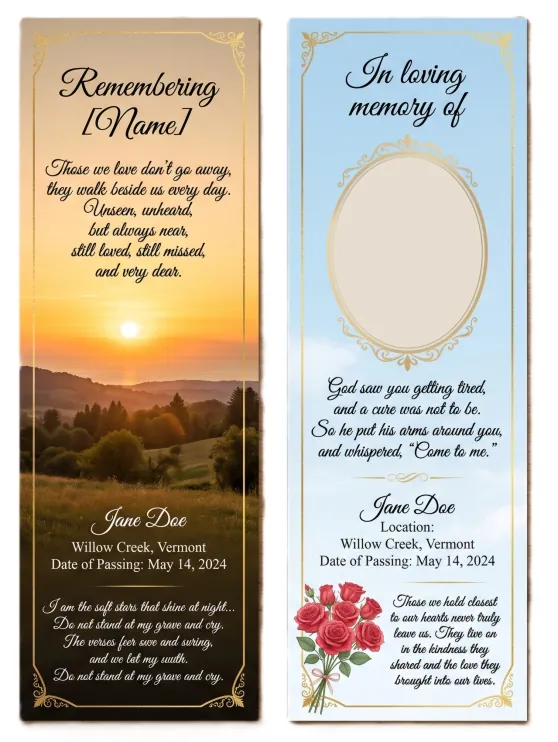
Send us this, and we will do the rest
A name, a home place, the dates, the photograph and either a verse ID or the wording you want. That is enough for us to set a full card. If anything is missing we will ring you rather than guess.
You will always see a proof by email or WhatsApp before we print, and you can ask for as many revisions as you need. Design and VAT are included in the price, and delivery is free on orders over €150.
Frequently asked questions
- What is the standard wording on an Irish memorial card?
- A heading such as “In Loving Memory Of”, the full name, the home place and county, the date of birth and date of death, and a verse or prayer. Anniversary cards add a line such as “Month's Memory” or “First Anniversary”.
- Should I put the age on a memorial card?
- It is optional. Many Irish cards use “Died 14th March 2026, aged 78 years” instead of listing both dates, which suits a card with limited space.
- Can a memorial card include two people?
- Yes. Cards for a married couple are common, usually with two photographs side by side and both sets of dates. A folded card gives the most comfortable layout for this.
- Do I need to register the death before ordering cards?
- No. Registering a death is a separate legal requirement handled through the civil registration service, and it does not affect when you can order memorial cards.
Sources and further reading
Need help with a memorial card?
Design and VAT are included, and we will email or WhatsApp a proof before anything is printed.
Talk to our design team