
A death notice is short, formulaic and read by more people in one day than anything else a family writes. The formula is a help, not a constraint — every phrase in it exists because it answers a question somebody will otherwise have to ring the house to ask.
Who writes it
In practice, the funeral director drafts and places the notice using details the family gives them. Families rarely write it from scratch, but they do approve it, and that approval is worth taking seriously — corrections after publication are awkward.
Notices in Ireland are typically published on rip.ie, read out on local radio in many areas, and sometimes printed in a local or national newspaper. RIP.ie is an independent service with no connection to us; we mention it only because that is where most people now read notices.
The six things a notice must carry
Everything else is optional. These six answer the questions people will otherwise ring to ask.
- The full name, including a maiden name where it is used, and any name the person was known by.
- The home place — townland, village or street, then the county.
- The date of death, and whether it was peaceful, at home, or in hospital or a nursing home.
- The family: predeceased by, and survived by, named in the usual order.
- The funeral arrangements: reposing, removal, Mass or service, burial or cremation, with times.
- How to sympathise: house private, family flowers only, donations in lieu, or condolences online.
The standard phrases, and what they mean
The set phrases in Irish notices are a shorthand everybody understands. Using them saves words and avoids misunderstanding.
| Phrase | What it means |
|---|---|
| Peacefully, at home, surrounded by her family | The death was expected and at home |
| Predeceased by his wife Anne | A named close relative died earlier |
| Sadly missed by his sons, daughters and grandchildren | The surviving family, named in order |
| Reposing at … on Thursday from 4pm to 6pm | Where and when people may call |
| House private, please | Callers to the family home are not expected |
| Family flowers only, donations if desired to … | Flowers are being kept small; a charity is named |
| Funeral Mass on Friday at 11am, followed by burial in … | The service and burial arrangements |
A worked example
BYRNE, Mary (née Kavanagh), Ballyduff, Bunclody, Co. Wexford — peacefully, on 14th March 2026, at Wexford General Hospital, in her 79th year. Predeceased by her husband Thomas. Sadly missed by her sons John and Peter, her daughters Anne and Claire, her sons-in-law, daughters-in-law, grandchildren, extended family, neighbours and friends.
Reposing at Doyle's Funeral Home, Bunclody, on Sunday from 4pm to 6pm. Removal to St Mary's Church, Bunclody, arriving at 6.30pm. Funeral Mass on Monday at 11am, followed by burial in the adjoining cemetery. Family flowers only, donations if desired to the Irish Hospice Foundation. House private, please.
Details worth checking twice
Townland spellings vary between families, parishes and maps. Whatever the family uses is right — but it should be the same on the notice, the headstone and the memorial card, and that only happens if somebody decides it once.
The order of family names matters more than people expect, particularly with second marriages, step-children and estranged relatives. It is the single most common source of upset in an otherwise perfect notice.
- Maiden name, and any name the person was actually known by locally.
- Townland spelling, and the correct county.
- Every name spelled as the person spells it, fadas included.
- Times and dates for reposing, removal and Mass.
- Whether donations are named, and to which charity.
The acknowledgement notice, months later
Many families publish a second, shorter notice thanking people. The wording is close to what goes on a thank you card: “The family of the late Mary Byrne wish to express their sincere thanks to all who sympathised with them in their recent bereavement”, usually closing with “The Holy Sacrifice of the Mass has been offered for your intentions.”
If you are printing acknowledgement cards anyway, write both at the same time. They share ninety per cent of their words.
Acknowledgement and thank you card wording →Thank you cards →
Why the notice is worth keeping
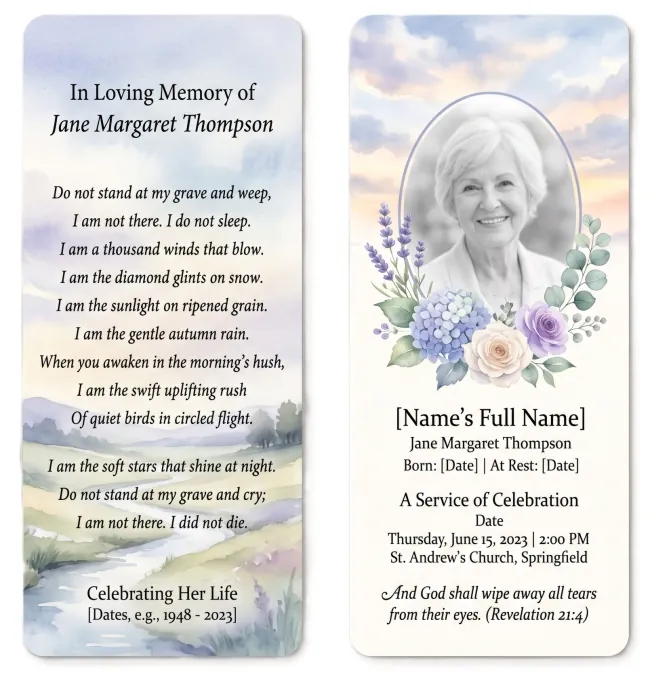
The notice already contains the exact name, the home place as the family words it, the date of death and the family line. That is most of a memorial card, checked and agreed at a point when several people read it carefully.
When families send us the notice along with a photograph, the first proof is usually right. It is the single most useful thing you can send us.
What to put on a memorial card →Memorial card wording examples →
From notice to card
Send us the notice, a photograph and a verse ID and we will set a full card from it. You will see a proof by email or WhatsApp, and revisions are free.
Design and VAT are included. Free delivery over €150 anywhere in Ireland, or collect free in Gorey.
Frequently asked questions
- Who writes the death notice in Ireland?
- The funeral director normally drafts and places it using details the family provides. The family should read and approve it before publication.
- What information goes in a death notice?
- The full name and home place, the date of death, the family who predeceased and survive, the funeral arrangements with times, and how people should sympathise.
- What does “house private” mean in a death notice?
- It asks people not to call to the family home. Sympathy is offered instead at the funeral home, the church, or online.
- Can I use the death notice wording on the memorial card?
- Yes, and we recommend it. The notice already has the agreed name, home place, dates and family line, so the first proof is usually right.
Sources and further reading
Need help with a memorial card?
Design and VAT are included, and we will email or WhatsApp a proof before anything is printed.
Talk to our design team